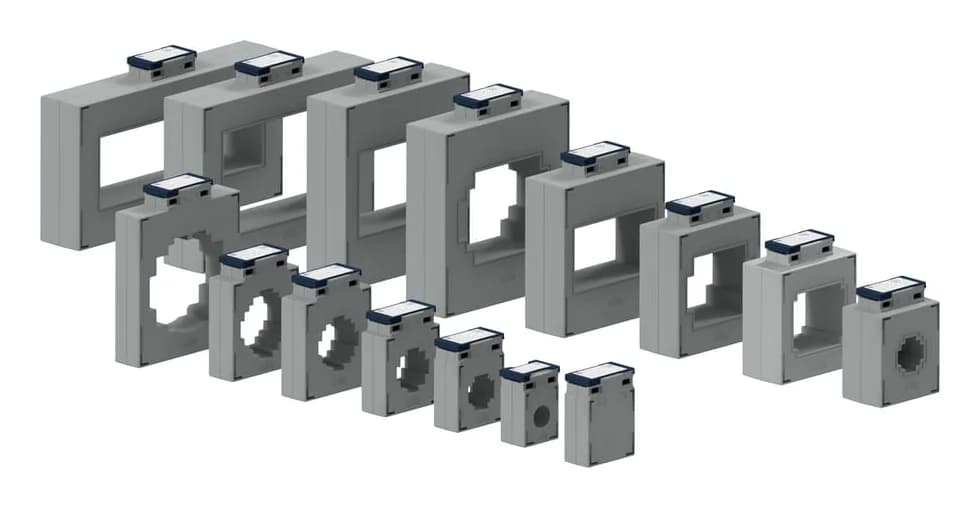
How a current transformer works
The primary conductor – a cable or busbar – passes through the core or is connected to the primary terminals. The alternating current creates an alternating magnetic field in the core, which induces a current in the secondary winding at the transformation ratio. With a 250/5 A transformer, 5 A flow on the secondary side when 250 A flow on the primary side.
Meters, energy meters or protection relays are connected to the secondary circuit. Their consumption and the wiring form the burden that the transformer must drive with its rated output in VA. If the burden is too high, the transformer saturates and reads low.
Important in operation: the secondary circuit of a current transformer must never be left open under load – dangerous voltages would arise at the terminals. CELSA ALO and KALO transformers therefore have an integrated short-circuit bridge.
Selecting the right current transformer
Five parameters determine the choice. The transformer finder asks for them one by one and shows the matching types with aperture and outer dimensions.
- Primary current – the rated current of the conductor, as close as possible to the actual load. A heavily oversized transformer is less accurate at partial load.
- Secondary output – 5 A for classic instruments and short leads, 1 A for longer secondary wiring, 333 mV for energy meters and monitoring systems with voltage input.
- Accuracy class – 0.2s, 0.5, 1 or 3. Billing and conformity-assessed metering require class 0.5 or better. Read more →
- Rated output in VA – must cover the consumption of the devices and the losses of the secondary wiring. The VA calculator determines the demand from cable length and cross-section. Read more →
- Conductor and space – cable diameter or busbar size define the window; mounting on DIN rail, busbar or directly on the cable.
Standards, quality and manufacturing
CELSA current transformers are manufactured to IEC 61869 parts 1 and 2 and DIN EN 42600 and are available in accuracy classes 0.2s, 0.5, 1 and 3. Some series are approved for official calibration or conformity-assessed metering.
The housing is made of self-extinguishing polycarbonate V0 to UL 94. Development, winding and testing take place in Römerberg – every type is stored as a variant with article number, datasheet and dimension drawing. Custom manufacturing to customer requirements is possible.